
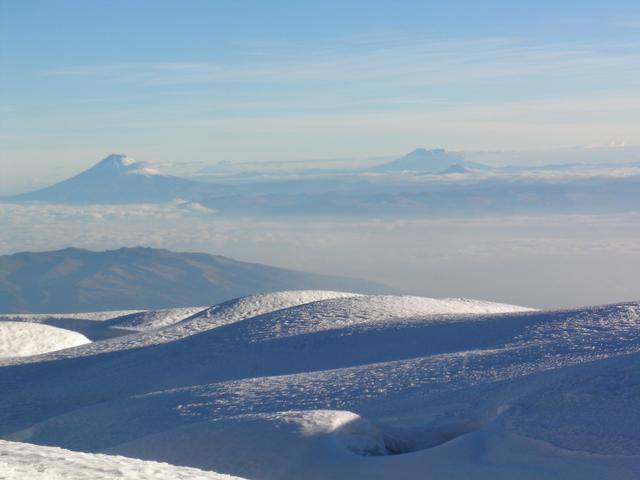
Ecuador, the second smallest country in South America, can offer great mountains and variety of climbing incomparable than any other country in the world. The easy access to the mountains means that expeditions can acclimatize and summit a range of different peaks in only a few weeks. The Andes were created 140 million years ago as a result of the movement of the ocean plate against the continent creating an impressive mountain the Amazon basin, with altitudes that vary between 2820m to 6310m, creating two parallel chains of mountains, the glacier peaks are located on the east range though the highest mountain Chimborazo is on the western range.
Ecuador is a mountaineer’s paradise, boasting a string of impressive volcanoes along the “Avenue of the Volcanoes.” While some peaks require advanced technical skills, Cotopaxi volcano is a popular choice for both experienced climbers and those with good physical condition looking for a challenging ascent, often requiring little or nor prior technical experience for guided trips but acclimatization is always recommended for a successful experience.
Climbing Cotopaxi typically involves a multi-day organized tour that includes acclimatization hikes to lower peaks such as Pasochoa and Pichincha before attempting the summit. The ascent itself usually starts from the José Rivas Refuge around midnight, aiming to reach the summit for sunrise. Due to the active nature of the volcano and the altitude, it is mandatory to climb with a certified mountain guide. Essential climbing equipment like crampons, ice axes, helmets, and harnesses are typically provided by tour operators or available for rent. Other notable peaks for climbing in Ecuador include Chimborazo – the highest point in Ecuador, and the closest point to the sun from Earth’s center-, other important peaks are Cayambe, Iliniza North & South and Antisana.
COTOPAXI CLIMBING ITINERARY
DAY 1 – Arrive to Quito airport and transfer to hotel.
DAY 2 – City tour – You will visit downtown colonial part of Quito and admire the Basilica Church, the Plaza Grande and San Francisco Church and then visit the Panecillo where you can have a great view of the city and the volcanoes. In the afternoon you will meet with a logistic support guide and go through check list of equipment and gear necessary for the following days. Night hotel.
DAY 3 – Pick up at hotel to hike Rucu Pichincha. You will be taken by vehicle to the cable car station “Teleferico”. The cable car leaves you at 4,000m where your hike begins to the summit which will take between 3 and 5 hours for the roundtrip to return on cable car and back to the car to return to hotel.
DAY 4 – Pick up at hotel for Pasochoa hike, our second day of acclimatization. This day hike begins after a 1h30 min drive that take you to 3100 m/ 10300 ft , where the head trail begins. The 4-5 hour round trip hike takes place along the back side of an ancient extinct volcano located in the central range of the Ecuadorian Andes along farmlands, cultivated fields, and paramo grasslands. The rim leading us to the highest point offers amazing views of the endemic forest. Return to hotel.
DAY 5 – Rest day at hotel near Cotopaxi, night at a hotel nearby
DAY 6 – Transfer to Cotopaxi volcano for glacier skills practice. Night at Cotopaxi hut or hotel nearby depending on climbing experience, as it is best to hike in high altitude and sleep low for better rest.
DAY 7 – Cotopaxi climb begins at the parking area 4500m / 14500ft on an easy 25–30-degree switch back slope that ends at the refuge 4800 m / 15500 ft. where after an hour hike on a rock and volcanic ash path along a 30-degree slope before you reach the entrance of the glacier at 5100 m/ 16800ft at this point crampons, rope teams, prussiks will be essential for a safer 5/6 hour climb to the summit.
DAY 8 – Cotopaxi summit – There is a 45/50-degree final ascent that heads straight up to the crater rim where the gradient decreases for a last 15-minute climb towards the summit. The descent back to the refuge will be approx. 2/3 hours following the same route with some rest stops to recover and enjoy the scenery on the way back. The group is met at carpark to return to Quito for farewell dinner, Night hotel in Quito or near Quito International Airport.
DAY 9 – Airport transfer to return to your country.
Itinerary subject to change depending on seasonal changes, last minute weather conditions or adjustment in itinerary
Climbing Equipment gear
The emphasis on equipment necessary for mountain travel follows two simple rules:
Lightweight and Functional. Cotton clothing should be avoided because it dries very slowly and is a poor insulator when wet, opt for wool or synthetics that “wick” the sweat and moisture away from your skin and keep you much warmer.
The layering system outlined is usually sufficient for most people, but if you tend to be colder, bring one extra medium layer such as a vest, which would be ideal for extra warmth around camp.
When making the final decision as to what goes into your pack, remember that it’s a fine science of taking just enough clothes and accessories to do the job, while not over-burdening yourself with items you probably will not use.
There are more hiking and climbing itineraries, just let us know your interests and we can customize them.
In the link above you can find more details and customize your experience.